Wednesday, March 16, 2016

Oryx and Crake

Oryx and crake is the story of a man trying to find meaning in his life. Snowman, the novel's decrepit main character, spends the majority of his days pondering the situation he now finds himself in as the last man on Earth. Well, sort of. Snowman is kept company by genetically modified people, the children of Crake as he calls them, that are quite peculiar in their ways. Snowman spends a lot of his time thinking about his childhood, the days when he was called Jimmy. His upbringing was tumultuous at best with his mother abandoning he and his father without a trace of where she had gone. His father quickly remarried to a woman that Jimmy described as "whorish" in demeanor. Jimmy was raised in a walled compound owned by a massive company that dealt with genetically modified organisms. As the world was ravaged by the ugly effects of climate change, these corporations rose to power as the ruling entities of the time. Jimmy does not fit into the analytical world confined within the walls of the compound and often debates the merits of human nature with his highly analytical friend, Crake.


Throughout this book I get the sense that Margaret Atwood wrote Oryx and Crake as a means to rectify her own inner debates about the existential direction of humanity. Crake, Jimmy's close friend, is nearly a polar opposite of Jimmy in the way he sees the world. Crake sees humans, animals, plants; basically any living thing for the complex biological systems that they are composed of. In his view, these systems are imperfect and can be improved upon by the scientific advancements of the times. If he had his way, and he eventually does, people would act according to a strict framework laid out by the laws of nature. Jimmy, on the other hand, serves as Atwood's answer to the analytical thinking of Jimmy's time and, I suspect, of our time. Jimmy sees the world for its artistic beauty - its perfection in its imperfections. If this book were to qualify as a climate change novel, and I firmly believe it does not, it wold rely on its philosophical discussions of human nature. In that regard, there is a clear link to climate change as human nature is what got us in this mess in the first place. I believe Atwood is providing her take on the age old discussion of man's place in nature. Where do we fit as co-inhabitants of this planet? How does science, technology, art, religion (to some extent), etc., fit in our lives and how does that shape the direction of human civilization? I fear I will not be able to answer such questions in a brief blog post, but have found reading this book to be rewarding as it has forced me to open my mind to such questions.

But, yeah, this is definitely not a climate change book.

Wednesday, February 24, 2016

Arctic Rising

Arctic Rising by Tobias Buckell is the story of an Earth where the arctic ice sheet has melted and the Northeast passage has opened - permanently. Massive oil companies are vying for the last few drops of oil left on Earth in the arctic waters, and people have colonized Thule, the name for the remaining mass of ice still remaining in the arctic. Smugglers routinely travel the passage and intentionally sink their ships full of radioactive waste made at the many nuclear power reactors that have been constructed across the world. Anika Duncan is in charge of an air ship that patrols the passage for these dirty boats to ensure that no more toxic waste can be dumped into the ocean (there are already exponentially high rates of cancer near bodies of water due to dumping). In the first quarter of the book, Anika and her copilot, Tom, are shot down by a smuggling crew and left to die in the icy waters they are eventually saved, but Tom later dies due to exposure. The smuggling crew is tracked down by the United States Navy (which is jockeying for dominance in the northern waters with none other than Canada) and taken into custody. Apart from being shot down, this all seems to be rather routine which is indicative of the new conditions that define this Earth.

This book presents and interesting take on the issue of climate change. Earth is certainly a different place, but it isn't necessarily uninhabitable or hellish. Turmoil is everywhere, no doubt, but, then again, that's true of Earth today. So far, this book has been quite enjoyable to read. It has dialogue that is honestly cheesy as hell, but the story has kept me interested.

Arctic Rising is a book about a climate changed Earth, but it doesn't go deeply into detail about the effects of climate change that have destroyed the planet. Instead, this book looks at the geopolitical and economic struggles that this new Earth has been enduring as a result of global warming. Thule, the lone remaining ice sheet that is being artificially held together by human intervention, is a colony of people from all over the world. It is experiencing many of the same issues that the original 13 colonies of the United States faced. Many many countries see this land as valuable due to the resources that remain there as well as the strategic benefits that come with dominating the top of the globe. The United States seems to have taken a back seat to Canada as a world superpower due to Canada's newfound economic activity in its once stagnant north. Many ports have been opened or expanded to accommodate for shipping traffic, making Canada the economic hub of the world.


Sunday, February 14, 2016

Dust in the wind


For those of you who may have seen Christopher Nolan's recent sci-fi epic, Interstellar, you might remember seeing interviews of people who survived the actual dust bowl of the 1930's. In fact, drought and dust storms play a role in the early scenes of the film, which helps the audience to gain a grasp of what a climate changed world might look like. Grapes of Wrath by John Steinbeck would then be the predecessor to Nolan's film. In the early pages of the novel, Steinbeck focuses on shaping the hellish alien landscape that the dust bowl transformed fertile farming ground into. Steinbeck meticulously details the land and yet his descriptions all revert to intricate means of describing different patterns of dust. Dust in the fields, dust in the air, dust in the kitchen, dust everywhere. Steinbeck's words bring to mind images of volcanic ash covering everything after a major eruption (like the recent eruption in Iceland).

Now, dust covering everything turned out to be a massive problem for people who lived in the dust bowl as it absolutely devastated crop yields and virtually hung farmers out to dry. Steinbeck describes fields of dust covered corn blown over by gusts of wind that persisted throughout the drought.  Sunlight was dimmed by the dust lingering in the air and plants were suffocated as a result. In reading Grapes of Wrath, one can see the potential for disaster that prolonged droughts will have on our planet. One of the details that stood out to me in reading this novel was Steinbeck's description of the exhaust fumes emitted by a truck that the character, Tom Joad, hitches a ride on early in the book. Of the truck Steinbeck writes, "The vertical exhaust pipe muttered softly, and an almost invisible haze of steel-blue smoke hovered over its end." If only he knew how important the "almost invisible haze of steel-blue smoke" would have on the planet in which he so painstakingly describes. Overall, Steinbeck's dust bowl ridden world is bleak, and its people are nearly hopeless.


Thursday, February 4, 2016

Clean Energy For All!

The Future of Energy: Lateral Power to the People is documentary surrounding the budding green energy movement occurring across the United States. Its creators searched high and low for grassroots clean energy movements in a town near you, and what they found was rather exciting. Entire cities were going green, and it was happening at a local level -- exciting stuff.


How long have we been told that solar power was going to cut it, that wind turbines were never going to power our future? Consider this report from OPEC which predicts, "...renewable energy grows fast. But as it starts from a low base, its share will be only 3% by 2035." Are these confident words the death blow to the environment as we know it? Maybe not. This film would argue that members of OPEC should be very, very concerned about their liquid black gold. Same goes for big coal.

Take, for example, Lancaster, California, a town that mandated that all new buildings be fitted with solar technology. This city has been able to reach nearly net zero emissions in doing so and, as mayor R. Rex Parris puts it,"we now have the ability to save the planet, increase the standard of living and the well being of everyone." This film certainly argues that green energy isn't environmentally responsible, but also socially and economically viable. In fact, one woman in the film calls the green energy movement, "the largest social movement in human history." It seems, according to this film, that green energy will help stave off our environmental woes and help lift people out of the darkness of poverty.


This film seems to crescendo, building on all of the ideas that have emerged in the green energy movement. People are:

  • building net zero emissions homes 
  • crowd funding solar projects
  • purchasing electric cars  
  • Rallying for policy changes 
These and many more are what make up the green energy movement across the globe. This multifaceted effort to save the planet is happening all around us and it is being led by people very much like you and I. This film proves that the green energy movement is happening, it's gaining momentum, and it is going to happen whether government policies and the fossil fuel industry like it or not. 


Monday, February 1, 2016

Oil and Honey: A Call to Action

Somehow, after reading the first half of Oil and Honey, Bill McKibben makes jail seem not so bad. In the first half of his book, he describes how his involvement with climate change came to be on a more intimate level. The doom that defines the pages of Eaarth is still there, but there is more at work in his words. McKibben has come to be a leader of change and while reading this book it is quite apparent that he is fit for the job. He knows his audience and utilizes his resources better than nearly anybody else in the climate change movement. All of his skills helped to lead two weeks of consecutive protests on the White House, resulting in 1,253 arrests and a couple nights stay in jail. Throughout, he admits his concern about the methods they are choosing to get their point across and doubts the ability of small grassroots movements to excite any change. Despite his doubt, his organized protests sparked a wave of protests all across the United States and even overseas. His personal climate change organization, www.350.org, has reached out to people in countries all over the world and has been wildly successful in getting its message across: we want our atmosphere back! His concern about grassroots movements is no longer necessary, as this has now become a global effort. McKibben himself constantly remarks at his surprise at how effective his work has been. 

So why is this story personal for McKibben? Throughout his travels across the globe, he reflects on his desire to return to his home in Vermont. Working with a local beekeeper, Kirk, he discovers a new connection to the Earth which helps him to find meaning in his work. Though he misses Vermont, he realizes why his work is absolutely essential -- he has to fight for this cause to save the land he calls home. He talks about his decision to purchase a plot of land as an investment to leave for his daughter: "Given what I knew about climate change, the gift of productive land seemed like the best thing I could hope to pass on to her, an insurance policy worth more than money in some account." McKibben cares for nature and wants to do what is right for its survival, and, in the pages of Oil and Honey, he argues that we should too. 

Tuesday, January 19, 2016

Chapter 2 -- Mosquitoes Are Scary

Mosquitoes are scary. What freaks me out the most about climate change isn't the violent storms and drought (well, that's sort of scary too), it's the spread of disease. We as humans have made incredible advancements towards eradicating horrible diseases like ebola and malaria and the prospect of these types of diseases making a comeback in a big way is frightening. We can pretty well predict when and where a massive storm is going to hit, but we don't have this type of capability for each individual mosquito that might be flying around our kitchens. This is what McKibben has to say about the spread of disease and its link to climate change:
"The link to climate change couldn't be clearer: not only do warmer temperatures extend the geographic range of the mosquito (up to half the world's population is now at risk), but Science Daily reports that global warming 'also reduces the size of Ae. aegypti's larva, and ultimately adult size. Since smaller adults must feed more frequently to develop their eggs, warmer temperatures would boost the incidence of double feeding and increase the chance of transmission.'"
 I don't know about you, but more mosquitos doesn't sound appealing. Toss in the chance of contracting a potentially lethal illness and this seems like it could become a massive problem. The first world isn't exempt from the spread of disease either as mosquitoes bite indiscriminately. This, mixed in with the decreasing effectiveness of antibiotics, certainly explains the white houses's public health approach to spreading climate change awareness. Below is a map prediciting the spread of west nile virus in The United States due to climate change (This is just one of many examples):


It seems clear that the health issues that almost exclusively plagued (no pun intended) the third world are becoming rather inclusive. We will see our national healthcare system put to the test as this issue is realized in the safe oasis that is the first world. Scientists believe that lethal viruses may be trapped in the permafrost of the north, and, as the permafrost melts, these illnesses will be reintroduced into society. This may be one of the most dangerous of all of the "positive feedback loops" that climate change will pose in the coming years.

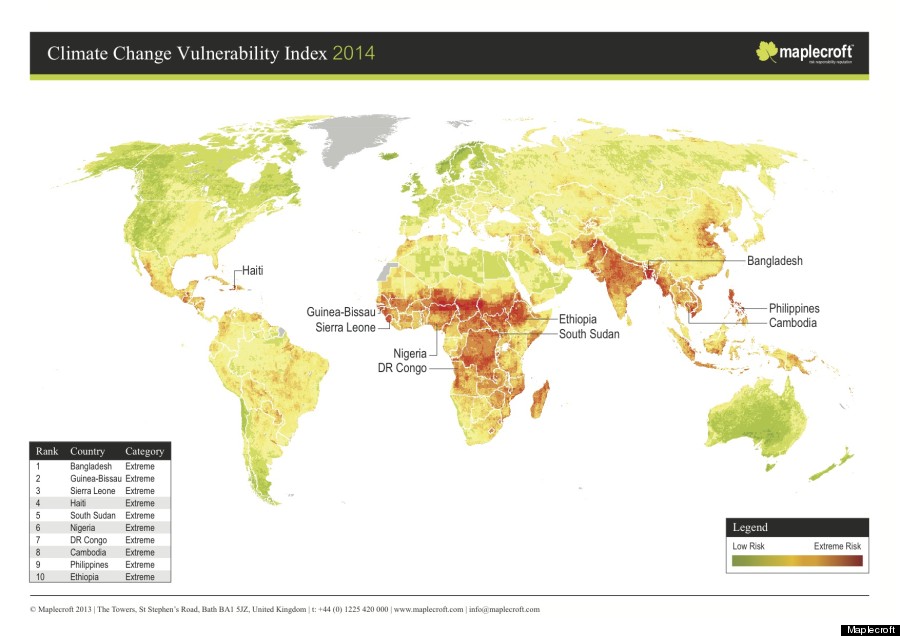
 Maybe this is just karma as the first world is largely to blame for climate change, yet sadly the third world is who will be the recipients of the worst of its effects as this map from the Huffington post shows: 

Alas, climate change is not fair. 

Monday, January 11, 2016

Chapter One - Doom, Gloom, and More Doom

In the approximately 50 pages that constitute chapter 1 of Bill McKibben's eaarth we are presented with a situation that can only be described as bleak. Wait, no; bleak would be putting it lightly. There could not be more impending doom, apocalypse-on-the-horizon-we-are-all-screwed rhetoric packed into this first chapter. Having some contextual background knowledge of the climate change situation, I can't help but attempt to fill in this black hole with some hopeful thought (alas, unfortunately not even light can escape a black hole).

I mean, after all, as an engineering student, I feel that technology is coming along and new ideas on how to manage carbon dioxide in the atmosphere are all reason for some hope, right? And with this climate summit in Paris taking place we are seeing a real concerted effort by the international community to step up to the plate, finally.

This first chapter serves as a reminder that this threat is very real and is now to be expected to become a daily (seasonally maybe?) aspect of our lives. It's as if McKibben took every negative news headline, academic journal entry, legislative shortcoming, and condemned them into one chapter. I guess this is what we get for kicking the can down the road. McKibben's argument is clear, this is not an issue that will affect his grandchildren (our children), it is something facing us today.